
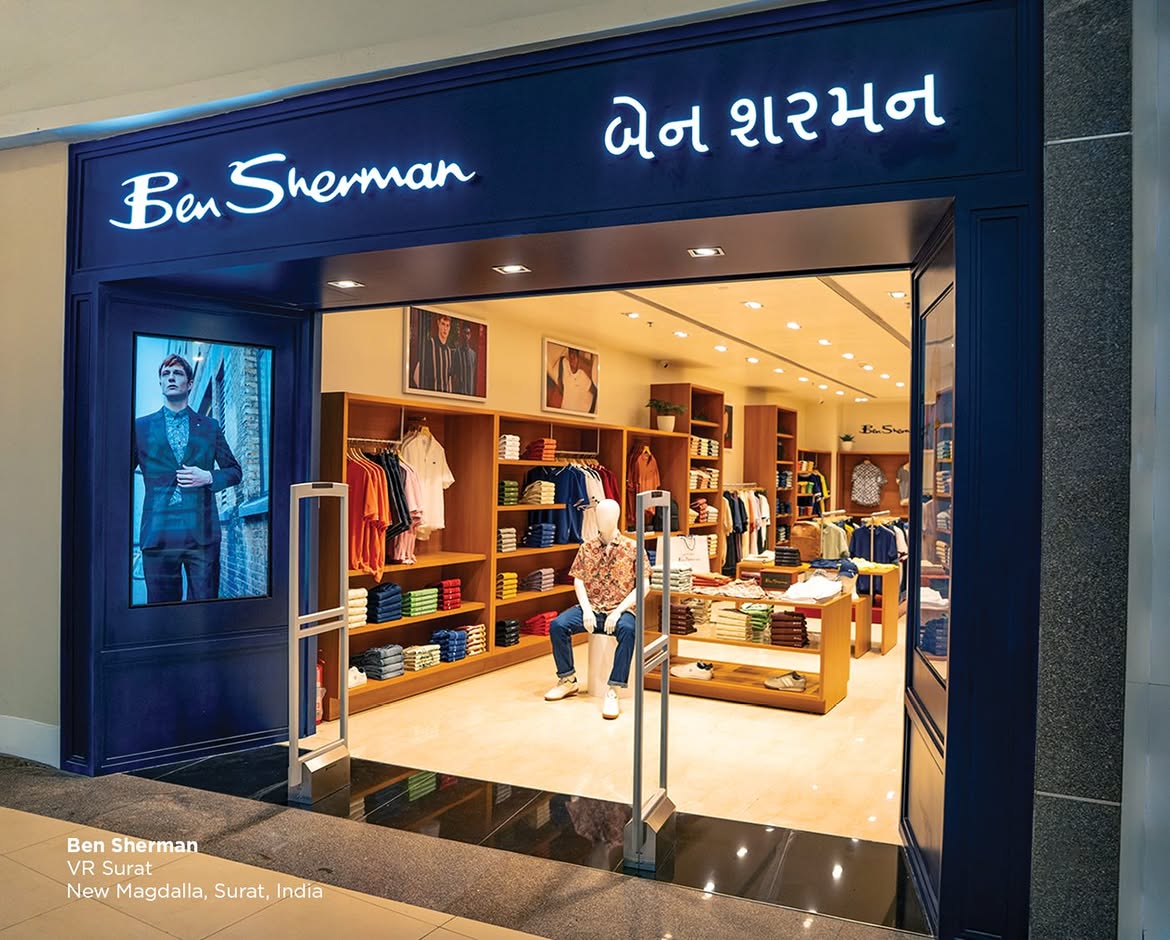
Ben Sherman, the British menswear label founded in Brighton in 1963, opened its first standalone store in India at VR Surat on 1 August 2026. The store operates through the Indian partnership involving brand owner Marquee Brands and Apparel Group India, the retail operator that added Ben Sherman to its India portfolio under a multi-brand licensing alliance.
The detail that matters is not the ribbon-cutting. It is the address. A British heritage label with a Mod inheritance has chosen Surat - a Gujarati city known globally for diamonds and textiles rather than for fashion retail debuts - as the site of its first physical store in the country, ahead of Mumbai, Delhi or Bengaluru.
Ben Sherman's Surat store at a glance
| Brand | Ben Sherman |
| Store status | First standalone Ben Sherman store in India |
| Opening date | 1 August 2026 |
| Location | VR Surat, Dumas Road, Magdalla, Surat |
| Indian operating partner | Apparel Group India |
| Brand owner | Marquee Brands |
| Promoted categories | Shirts, polos, knitwear, jackets, trousers, tailoring, footwear and accessories |
| Further expansion | Additional stores reported as planned; no confirmed city list or timetable |
| Not disclosed | Store area, investment, opening sales, full price architecture, confirmed next locations |
1. This is Ben Sherman''s store debut - not its first Indian availability
It is worth separating two things that are often collapsed into one headline. Ben Sherman entered the Indian market in 2025, when Apparel Group brought the label to Indian shoppers alongside BCBG, with availability reported through online channels. What happened in Surat is narrower and, commercially, harder: the brand now has a physical address of its own, with rent, staffing, stock depth and a fixed catchment.
An online launch tests interest. A standalone store tests conviction. The first is a listing decision; the second is a lease.
2. Why Surat?
Neither Ben Sherman, Marquee Brands nor Apparel Group India has publicly issued a detailed rationale for choosing Surat as the first standalone location. That absence is the most important fact in this section, and everything that follows should be read as editorial hypothesis rather than confirmed company reasoning.
Four explanations are plausible. The first is venue: VR Surat is a positioned mall property on Dumas Road, and international brands frequently anchor their first physical presence to a landlord that already aggregates the right footfall rather than to a city''s general reputation. The second is consumer base: Surat''s diamond and textile economies have produced a deep pool of high-income households whose spending has historically been under-served by international menswear at this price level. The third is operating economics: rents, staffing costs and fit-out spend in a tier-two market are materially lower than in Mumbai or Delhi, which lowers the cost of learning what Indian shoppers actually buy from this brand. The fourth is geography: Apparel Group''s wider western-India ambitions make Gujarat a coherent first move, with Ahmedabad and Mumbai reachable from the same supply and management structure.
What cannot be said is that Surat was chosen because the brand judged it superior to the metros. No company statement supports that, and the launch of a single store is not evidence of a strategic ranking of cities.
3. From Brighton youth culture to Indian mall retail
Ben Sherman was founded in 1963 in Brighton, and the label''s own heritage account centres on the button-down shirt - a precise collar, a defined placket, a shirt cut to be worn rather than merely owned. That shirt became a uniform of Mod culture and, through successive British youth movements, an artefact of subcultural identity rather than a purely commercial product.
That inheritance travels awkwardly. In Britain, the shirt carried a reference: scooters, soul records, a specific idea of working-class precision. In an Indian mall in 2026, the same shirt arrives without the surrounding culture. It has to compete on cut, fabric, fit and price, and its story has to be told at the shop floor rather than assumed.
4. What Ben Sherman will compete against in India
The premium-casual menswear shelf in Indian malls is crowded. International labels in the accessible-premium band already hold prime space, domestic premium brands have improved fit and finish considerably, and the direct-to-consumer shirt category has trained younger buyers to expect specific collar and fabric detail at lower prices.
Ben Sherman''s defensible ground is narrow but real: a documented shirt-making point of view and a British reference that few competitors in this band can claim honestly. Whether that is legible to a Surat shopper choosing between four stores in one atrium is precisely what the first store will reveal.
5. Is the Indian assortment locally adapted?
There is no public confirmation of India-specific product, sizing, fabric weights or local manufacturing. The promoted categories - shirts, polos, knitwear, jackets, trousers, tailoring, footwear and accessories - describe a full-format menswear offer rather than a shirt-led capsule, but the composition of that offer for Indian summers has not been detailed.
This matters more than it sounds. A brand built on a structured shirt entering a market where breathable, lighter-weight construction wins nine months of the year has a technical problem to solve, not just a marketing one.
6. Can subculture survive licensing?
Ben Sherman is owned by Marquee Brands and operated in India by a licensee. Licensing is neither a scandal nor a guarantee. It is a structure with a predictable trade-off.
On the useful side, an experienced regional operator brings mall relationships, staffing systems, supply logistics and the ability to open stores quickly - capabilities a foreign brand would spend years building alone. On the risk side, distance opens between the brand''s custodians and the people executing it in the store, and heritage becomes a set of assets to be applied rather than a culture to be maintained. The visible test is whether the Surat store reads as a considered expression of a Brighton shirt-maker or as generic premium-casual retail with a British logo.
7. Is Surat becoming a premium-fashion launch market?
One store does not make a market. It is accurate to say that Surat now hosts a first-in-India standalone store for an international menswear brand, and that this is unusual enough to be noted. It is not accurate to claim that Surat has overtaken the metros, that a tier-two luxury boom has been proven, or that other brands will follow.
The honest reading is that Indian tier-two cities have moved from being expansion markets to being viable entry markets for certain brands at certain price points - a shift in sequence rather than in hierarchy.
8. What remains unknown
A meaningful amount. The store area and investment have not been disclosed. Indian price bands have not been published. Whether stock is imported or locally sourced is unconfirmed. There is no verified information on opening-week footfall or sales. Reports indicate additional stores are planned, but no city list or timetable has been confirmed, including whether Ahmedabad forms part of the next phase.
9. What the first store will actually test
Three things, in order. Whether a British shirt heritage converts into repeat purchase when the surrounding subculture is absent. Whether the price architecture lands between aspirational and unaffordable for a Surat customer who has other international options in the same mall. And whether the licensing structure can hold a specific brand identity across a rollout rather than diluting it by the third store.
Those answers will not arrive from an opening announcement. They arrive in the second season, when the newness has worn off and the shirt has to sell on its merits.
What we are still verifying
- Exact store unit and floor at VR Surat
- Store area and investment
- Indian price bands
- Imported versus locally sourced stock
- India-specific sizes or products
- Opening footfall and sales
- Confirmed next-store cities and dates
- Whether Ahmedabad is part of the next phase