
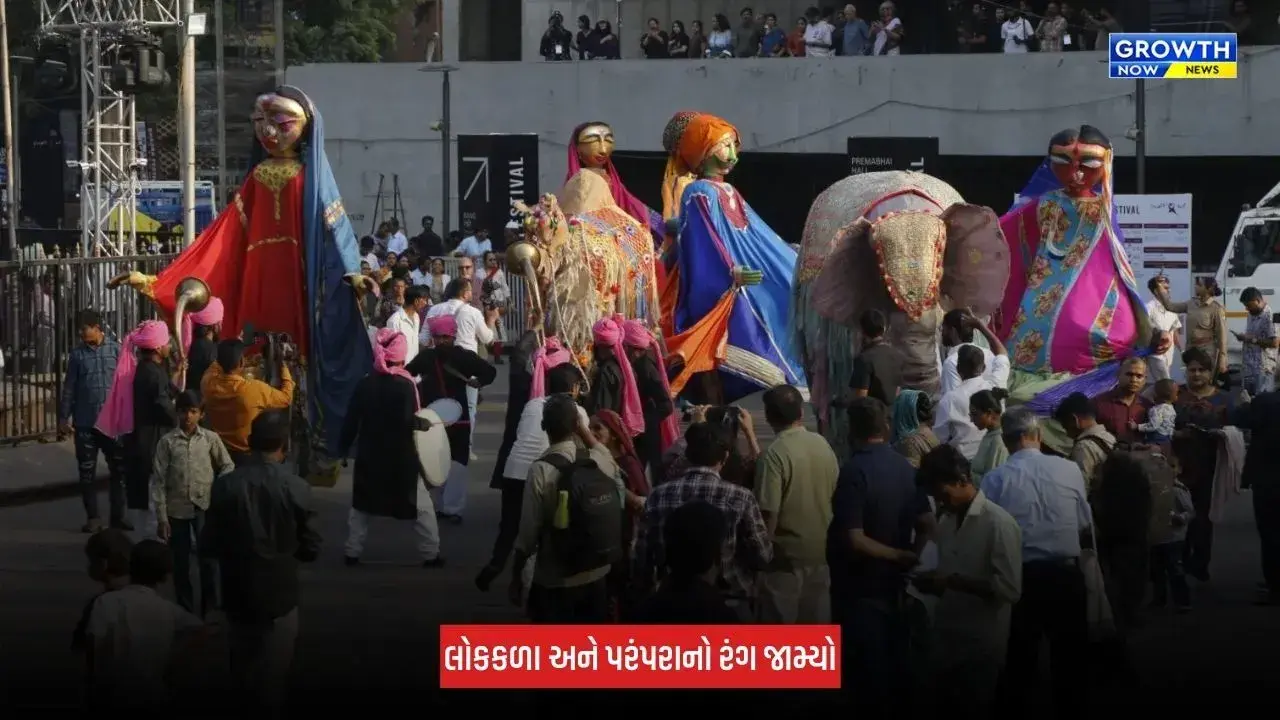
On an ordinary afternoon, Bhadra is never silent. Hawkers call out prices outside Bhadra Fort, scooters nose through the crowd near Teen Darwaza, and bells from the Bhadrakali temple drift over the noise. But it is the sound of a place that has stopped expecting anyone to look up. On 19 November 2026, that changed. From four in the afternoon, the Bhadra Festival returned to Ahmedabad's walled city for the first time in twelve years, and the square that once hosted royal processions was asked to perform again.
A homecoming, twelve years in the making
The festival is the work of Craft Of Art, the cultural organisation now in its seventeenth year, and this edition was a return to the ground where its Bhadra story began. The programme spread across Bhadra Fort, Bhadra Plaza, Teen Darwaza and the Premabhai Hall precinct. It arrived with the support of the Amdavad Municipal Corporation as part of World Heritage Week, and with a deliberately open door: entry was free, with registration on BookMyShow for the fort and the main concert.
That choice matters more than it seems. A heritage festival behind a steep ticket can feel like a museum visit. One that asks only for your name feels like being invited home. Among the many events in Ahmedabad this winter, few have made the case for the old city quite so plainly.
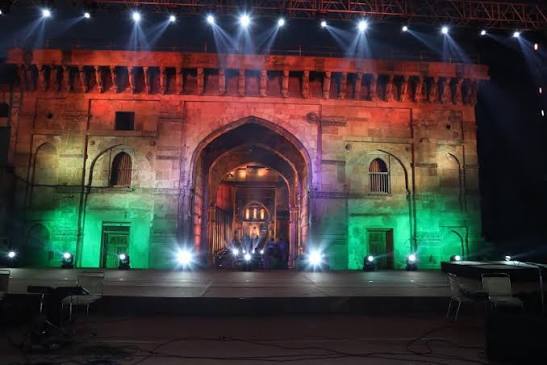
Bhadra Fort and Maidan-e-Shah: where Ahmedabad began
Bhadra Fort in Ahmedabad was founded by Sultan Ahmed Shah in 1411 as the citadel of his new capital, and the open ground between the fort and Teen Darwaza was known as Maidan-e-Shahi, the royal square that once hosted processions and public activities. The Bhadrakali temple in Ahmedabad, which gives the fort its name, still anchors the precinct. That was the brief the festival set itself: to treat Bhadra not as a monument behind a railing, but as a square built for gatherings, and to fill it.
Strings and skins at Teen Darwaza
The centrepiece was the 7:15 pm concert beneath Teen Darwaza, the triple gateway that has framed the walled city since the fifteenth century, and its line-up was built as a contrast.
Ustad Fazal Qureshi, the tabla player and youngest son of the late Ustad Alla Rakha, headed an ensemble that leaned towards fusion: George Brooks on saxophone, Rahul Wadhwani on keyboards, Sheldon D'Silva on bass and Arun Kumar on drums. It is a format made for conversation, the tabla trading phrases with a jazz horn over a modern rhythm section.
Ustad Shujaat Khan was programmed to follow on sitar. The son of Ustad Vilayat Khan and a leading voice of the Imdadkhani gharana, he is known for the gayaki ang, a style that makes the sitar phrase like a human voice, and for singing alongside his playing. He was billed with Amit Choubey and Sapan Anjaria on tabla, with actor Manav Gohil as host.
A fusion set and a classical recital back to back, under a gateway built for processions, was the evening's argument in miniature: the old city can hold both.
The plaza as a folk theatre
Before the concert, the afternoon programme handed the plaza to folk traditions from Gujarat and its neighbours, each chosen for a space that rewards noise and movement.
Pushkar's Nathulal Solanki and his troupe were listed for the nagara, the great kettledrum once used to announce kings and fairs, a fitting sound for a former royal square. Vijanand Turi was billed on the ravanhatha, a bowed folk fiddle with a coconut-shell body, often described as an ancestor of the violin and tied in legend to Ravana himself.
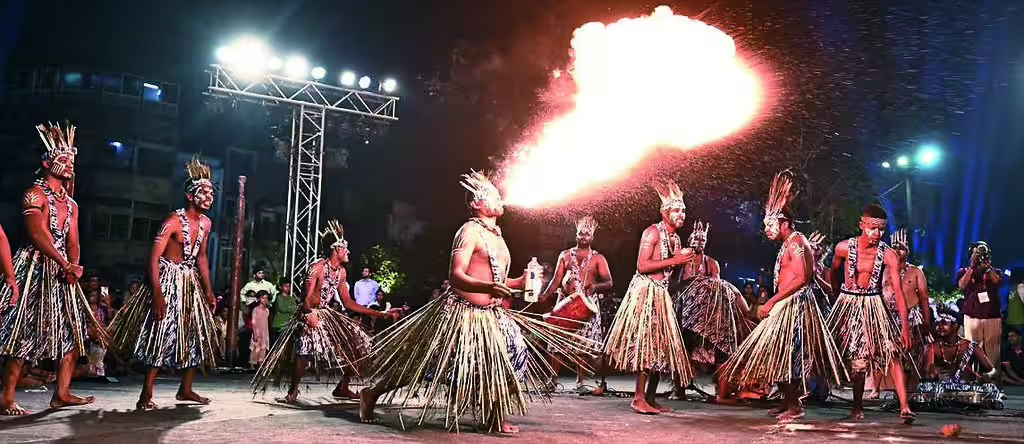
The Sidi Goma Dance Group was programmed to perform dhamal, the ecstatic dance of Gujarat's Sidi community, descendants of East Africans who arrived on this coast centuries ago. Driven by the large mugarman drum, it is one of the few living links between Gujarat and Africa, and it belongs in a city that has always been made by people who came from elsewhere.
The line-up also included Incredible Mallakhamb, whose performers hold poses on a vertical wooden pole that demand the strength of a wrestler and the poise of a dancer. Moving through the crowd was a Giant Puppet Parade by Ishara Puppet Theatre and its founder Dadi Pudumjee, the Padma Shri puppeteer whose oversized figures were built tall enough to look the fort walls in the eye.
Stories told in stone and light
Ahmedabad has always been a city of storytellers, and the festival offered them its walls. Utopia was programmed with Dastan-e-Darwaza, a dastangoi, the Urdu art of spoken storytelling, shaped around the gateway itself. Alongside it came Bhadraakhyan, drawn from the akhyan, the old Gujarati form of sung and narrated verse. Nisarg Trivedi and his actors brought Natya Sangeet with Gems of Gujarati Rangbhoomi, a return to the songs of the Gujarati stage from the days when theatre companies toured with their own orchestras.
The exhibitions supplied the memory. Rang: The Living Archives of Gujarati Theatre was curated by Manvita Baradi, Bhadra Unposed gathered photographs by Vinay Panjwani, and Bhadra Remembers drew on archival images of the precinct.
The evening's plan had the buildings take over after dark: projection mapping across the face of the fort and, in the Premabhai Hall precinct, Mata ni Pachedi, Gujarat's hand-painted shrine cloths, rendered in light across the facade. It is the same patience found in the state's other textile lineages, scaled up to the size of a building.
What a festival asks of a heritage city
In 2017, the Historic City of Ahmedabad became India's first World Heritage City, a title that rests on the Bhadra citadel and the close-knit pols of Ahmedabad. Evenings like this one are how that title stays alive rather than hanging on a plaque. They remind the city that the old city of Ahmedabad is more than a stop on a heritage walk in Ahmedabad: it is still a public square, and it still knows how to hold a crowd.
The season is not over. Craft Of Art's Water Heritage Series follows on 25 November across three of the city's historic stepwells. If Bhadra was a reminder of where Ahmedabad began, the stepwells will show how it learned to last. Twelve years was a long wait. Here's hoping the next one is shorter.