
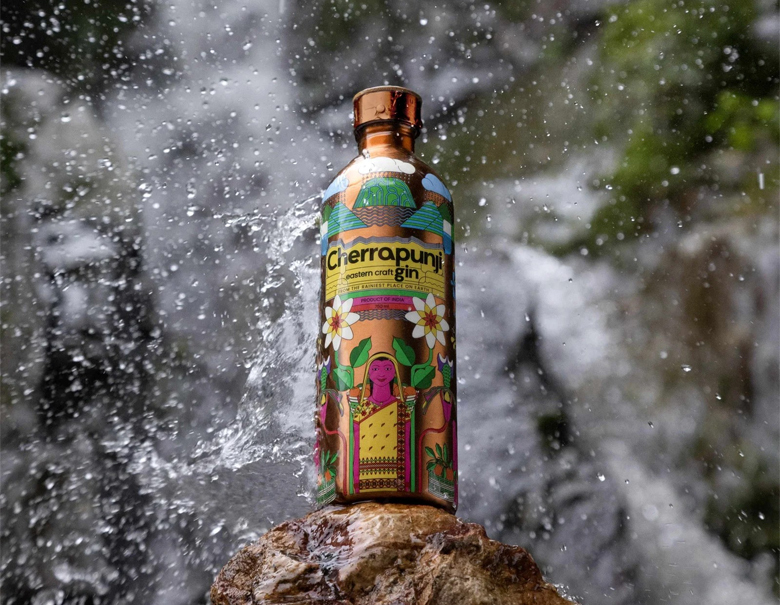
Cherrapunji held the world record for annual rainfall for over a century, and it's still one of the wettest inhabited places on the planet. In 1861, the town recorded 22,987 millimeters of rain in a single year, a number that's hard to picture even for people who've lived through a brutal Indian monsoon. And yet the same town runs dry every winter. That contradiction, absurd amounts of water for four months, real scarcity for the rest of the year, is the entire premise behind Cherrapunji, the gin.
The science of drinking the rain
Roughly 70 to 90 percent of Meghalaya's rainfall arrives in a tight window between June and September. The rest of the year, especially from November through February, villages depend on spring water and public taps that run for a few hours a day. The rain doesn't stay where it falls either. Cherrapunji sits on steep, rocky terrain that sheds water fast, so most of that historic rainfall runs straight off the hills instead of soaking in.
The distillers behind Cherrapunji gin harvest rainwater during the wet months and use it as the base for distillation, effectively bottling the one resource the region has in genuine, if temporary, abundance. It's a clever answer to a real geographic problem rather than a marketing flourish, and it only works because someone in the supply chain actually had to think hard about where Meghalaya's water goes and why so little of it sticks around by winter.
Botanicals from the Northeast, not a spice cabinet
The gin's flavor comes from a set of botanicals that read like a map of Northeast India rather than a standard London Dry recipe. Kaji Nemu, a citrus grown almost exclusively in the region, provides the peel. Khasi mandarin adds its own citrus note, distinct from the Kaji Nemu and specific to the hills around Cherrapunji. Cardamom comes from the Garo Hills, juniper is sourced from Sikkim, and there's smoked tea from Manipur folded in for depth. None of these are exotic add-ons chosen to sound impressive on a label. They're what's actually growing within a few hundred kilometers of the distillery.
Ditching glass for a steel bottle that lasts over a decade
The bottle is arguably the bigger story than the gin itself, at least from a design standpoint. Instead of glass, Cherrapunji ships in a bottle made from SS304 stainless steel. It weighs just 158 grams, considerably lighter than a comparable glass bottle, and it's built to hold up for over 12 years of reuse rather than being tossed after one pour-through. It's also fully recyclable at the end of its life, which glass technically is too, but rarely actually gets recycled given how heavy and breakage-prone it is to transport.
Steel solves a genuinely annoying problem with premium spirits packaging: glass bottles are fragile, heavy to ship, and mostly designed to be thrown away or, at best, repurposed as a candle holder. A steel bottle can survive being dropped, shipped internationally without excessive padding, and refilled or reused in ways glass just can't handle.
For a brand shipping out of Northeast India, where road logistics into hill towns like Cherrapunji are genuinely rough, that durability isn't a nice-to-have. Glass breakage on those routes would eat into margins and, more practically, mean bottles arriving at export markets with a meaningful damage rate. Steel turns a supply-chain weakness into something closer to a non-issue.
A jigger built into the cap
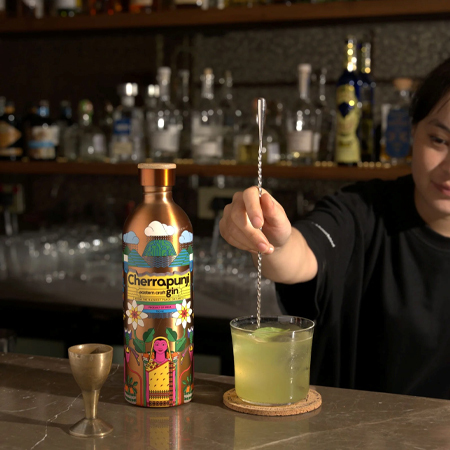
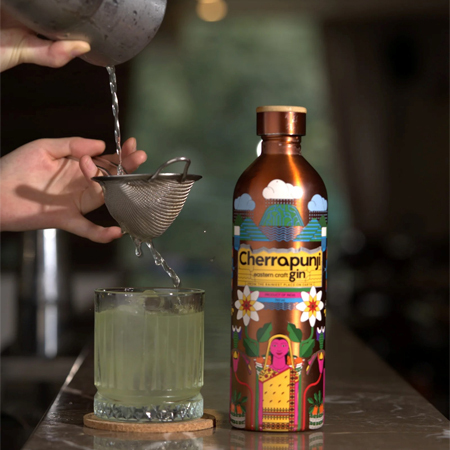
The other functional detail worth calling out is the cap, which doubles as a measuring device. It pours precise 30 ml and 60 ml measures without needing a separate jigger on hand, collapsing the usual open-measure-pour sequence into a single motion. It's a small thing until you're actually making a drink at home without bar tools nearby, at which point it becomes the difference between eyeballing a pour and getting it right.
That kind of functional thinking, building the tool you'd normally need separately into the bottle itself, is rarer in spirits packaging than it should be. Most premium bottles optimize purely for how they look on a shelf. Cherrapunji's cap optimizes for the moment you're actually using it.
Art that carries the region, not just the label
The bottle's surface carries hand-illustrated artwork referencing Khasi culture and the Meghalaya landscape, rather than the generic botanical line drawings most craft gins default to. It's a distinction that matters more than it might seem. A lot of "regional" spirits treat the place they're from as a flavor note and little else, printing a vague mountain silhouette and calling it done. Cherrapunji's illustration work is specific to Khasi visual traditions and the actual geography of the region, which means the bottle is doing some of the same representational work the gin's botanicals are doing: this is from here, specifically, not from a general idea of "exotic India."
Winning on the object, not just the liquid
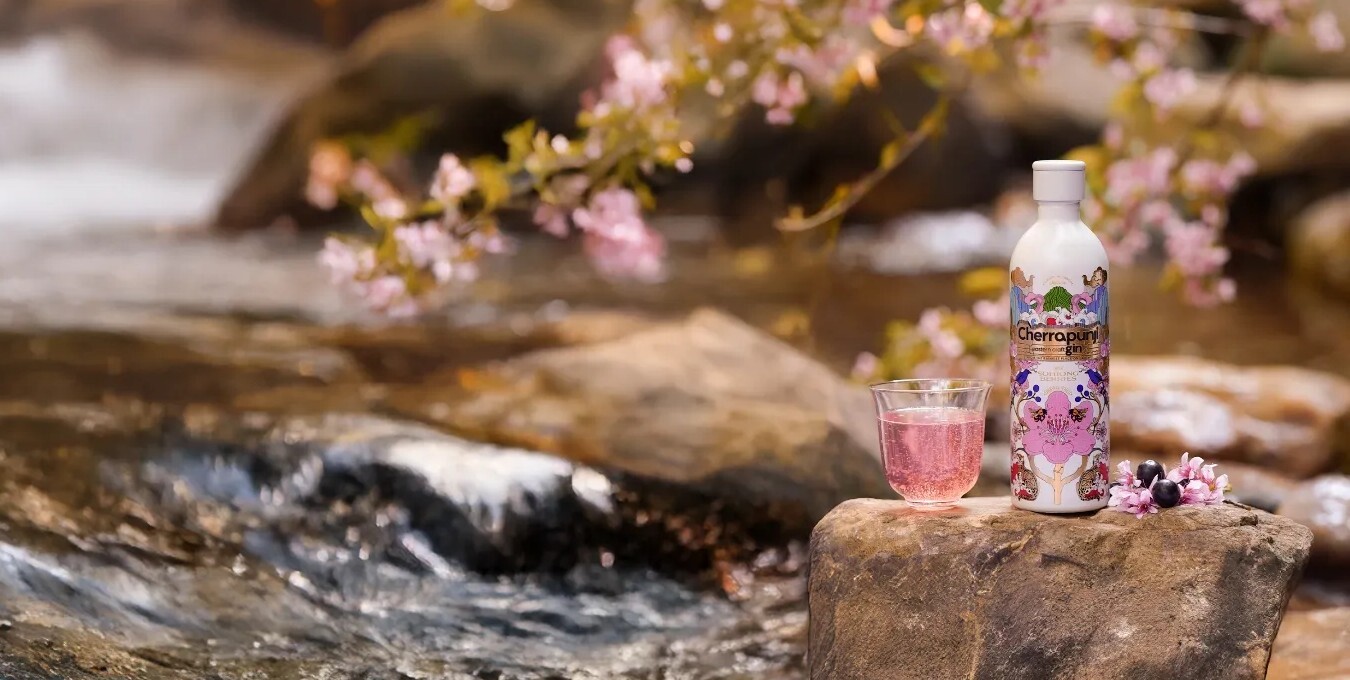
In 2026, Cherrapunji Eastern Craft Gin won the Red Dot Award for Product Design, one of the most respected industrial design honors in the world, established in 1954 and judged across more than 50 categories against thousands of entries annually. It's worth being clear about what that award actually recognizes: not the taste of the gin, but the bottle as a physical object. Red Dot judges evaluated the steel construction, the durability claim, the built-in jigger, and the overall functional design, the same criteria they'd apply to a piece of furniture or a kitchen appliance.
That's a genuinely unusual way for a spirits brand to win recognition, and it says something about where Cherrapunji's actual innovation sits. Plenty of craft gins have interesting botanicals. Far fewer have rebuilt the bottle itself as a functional, long-lasting object worth judging on its own terms. For a brand built out of one of the wettest, and now increasingly water-stressed, places in the world, that emphasis on durability and reuse feels less like a design trend and more like the whole point.