
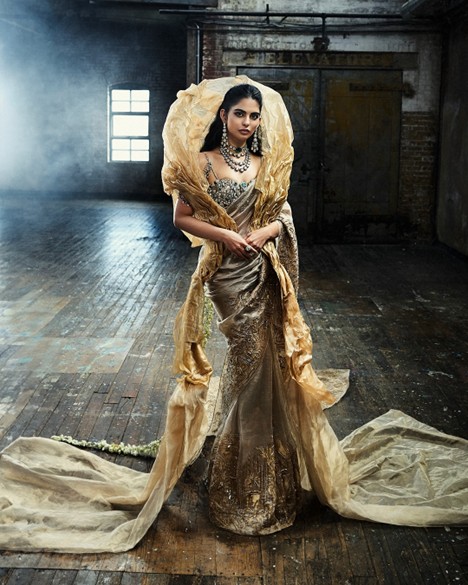
THE LOOK By the time Isha Ambani ascended the Met steps, the night had already accumulated its share of spectacle. What stopped the crowd was not the nine yards of Banarasi tissue silk woven with real gold thread, though it shimmered as if lit from within. Nor the blouse set with over 1,800 carats of heirloom diamonds, emeralds, and polki pulled from her mother's private collection. It was the jasmine in her hair a paranda-style trail of cream-white mogra blossoms that moved with the quality of something alive. They looked, in every photograph, like real flowers. They were made entirely of paper.
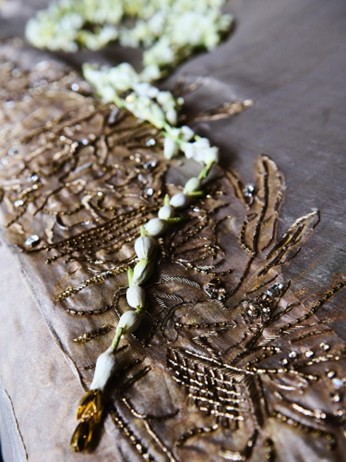
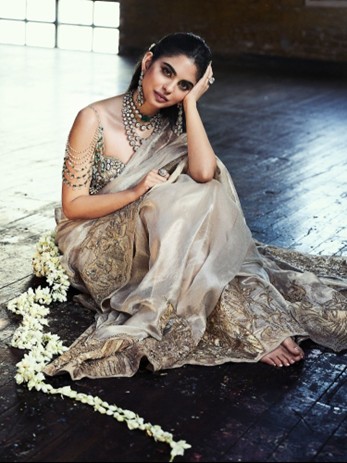
THE SARI This was Ambani's sixth Met Gala and her first in a traditional sari. The decision carries more weight than it first appears. Created by Gaurav Gupta, the six yards of handwoven Banarasi tissue carry Pichwai motifs drawn from the Ajanta cave murals, painted over 150 hours by National Award-winner Trilok Soni, then worked over in zardozi, aari, and dabka by Gupta's embroiderers. A second sari was sculpted in resin into a halo-like architectural cape. The blouse was constructed alongside her family's jewelers, with over 1,000 heirloom stones sewn directly into the fabric among them, a historic Nizam's sarpech set in rose- and table-cut diamonds. "It's a hand-woven sari," Ambani said simply, "and the blouse is full of my mother's jewelry." The restraint of that sentence is the whole philosophy of the look.
"It's a hand-woven sari, and the blouse is full of my mother's jewelry." — Isha Ambani
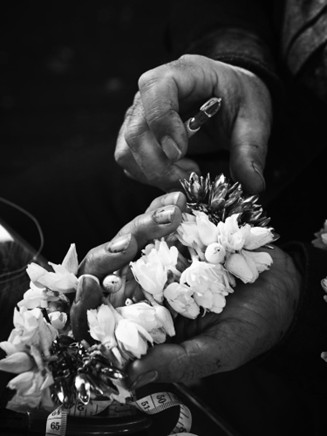
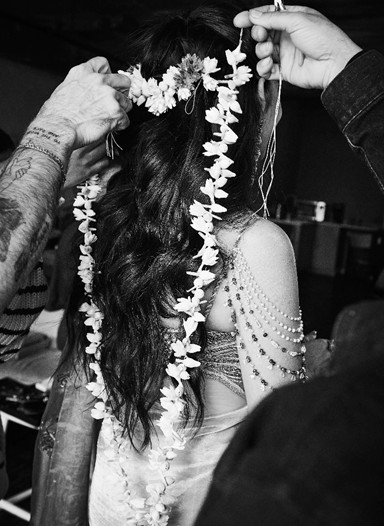
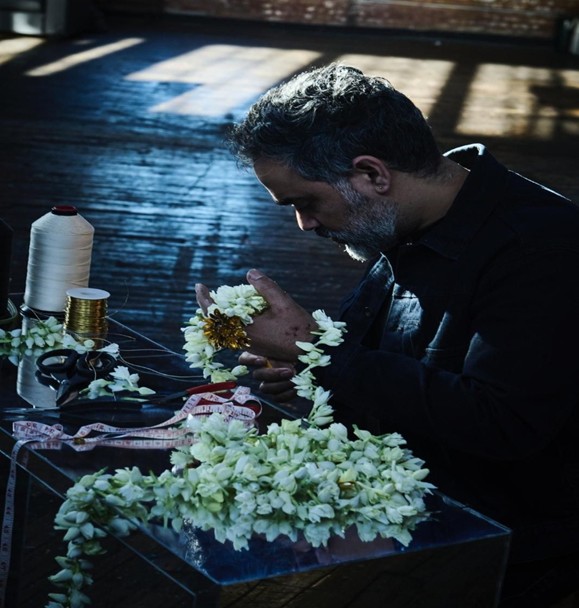
THE FLOWERS Sourabh Gupta is 35, Brooklyn-based, and grew up in Hiranagar, Jammu and Kashmir. His studio 5,000 square feet in Brooklyn is where the gajra was made over a single sleepless week. Stylist Anaita Shroff Adajania brought him a brief rooted in Raja Ravi Varma paintings and the traditional mogra gajra worn by Indian women for centuries. She wanted something that honoured that tradition while departing from it completely. Each flower was hand-cut, hand-painted, and fitted with copper and brass wire stamens. The team made over 1,000 blooms; 600 survived the selection. "You would pluck thousands of flowers to finally get the most beautiful ones." — Sourabh Gupta
WHY IT MATTERS The gajra became the detail the internet could not move past not the diamonds, not the gold thread, not the Nizam's sarpech. A piece of paper ornamentation, made in Brooklyn for less per unit than the silk it accompanied, became the most discussed element of one of fashion's most watched nights. That is the range of Indian craft as it exists right now: from ancient to contemporary, collective to individual, immeasurably precious to irreducibly personal. Isha Ambani's 2026 Met Gala look holds all of it. What remains, after the red-carpet analysis has settled, is the image of 600 paper flowers carrying the full weight of a real memory which is, in the end, what the most lasting fashion has always done.
Couture: Gaurav Gupta · Hair Sculpture: Sourabh Gupta · Styling: Anaita Shroff Adajania Textile: Swadesh · Pichwai Painting: Trilok Soni · Mango Sculpture: Subodh Gupta