
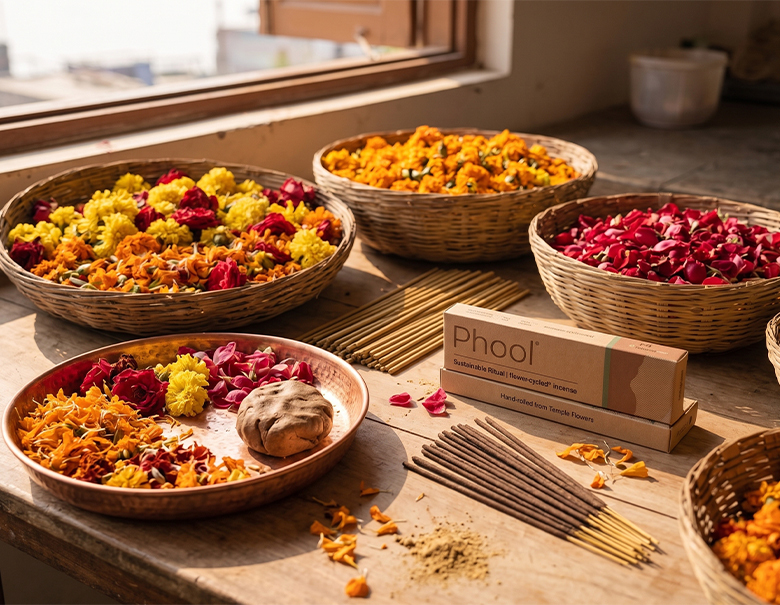
Ankit Agarwal grew up in Kanpur, a few minutes from the ghats. He knew the Ganga the way most people from the city do, as a backdrop, until the morning he walked down to the river with a childhood friend and actually looked at it. Marigolds and roses, still tied in the morning's temple offerings, sat rotting in water thick with pesticide runoff. That image is the reason Phool exists.
It's worth sitting with the scale of the problem before getting to the fix. Temples across India go through flowers by the truckload, and almost none of it is composted or reused. Estimates put the amount of pesticide-laden floral waste dumped into the Ganga alone at more than 8 million metric tons a year. It doesn't just look bad. It rots in standing water, feeds bacteria, and has been linked to outbreaks of diarrhea, hepatitis, and cholera in communities downstream.
Agarwal quit his job, put roughly ₹72,000 of his own savings into researching what actually happens to a flower after it's offered and discarded, and spent months figuring out whether that waste could become something else. In 2017, he and Prateek Kumar founded Phool to answer that question at scale.
From offering to incense
The process Phool eventually landed on is fairly simple to describe and considerably harder to run every day at volume. Flowers are collected from temples across Kanpur and, later, other cities in Uttar Pradesh and Bihar, before they're dumped. They're sorted, cleaned, and dried, then hand-rolled into incense using a flowercycling method the company developed in-house. No bamboo core, no charcoal, no synthetic fragrance oils standing in for the real thing. Just the flowers themselves, processed back into a form you'd actually want to burn in your home.
At last count, Phool was pulling in around 11.4 tons of temple waste a day. That's not a pilot-project number. That's a supply chain.
Getting there took more patience than most founders would put up with. Flowers rot fast, so collection routes had to be built around temple schedules in Kanpur first, then extended city by city as the process proved it could handle more volume without the quality of the incense slipping. Every new city added its own version of the same logistics problem: which temples to work with, how to collect daily without disrupting worship, how to keep flowers from spoiling in transit during a Uttar Pradesh summer. None of that shows up in the finished box of incense, but it's most of the actual work.
Why charcoal-free matters more than it sounds
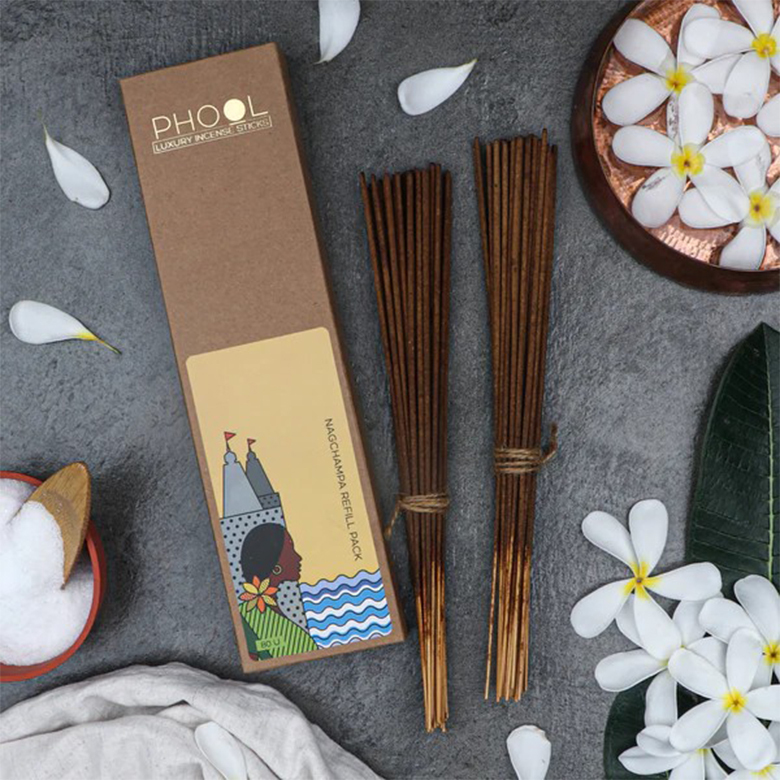
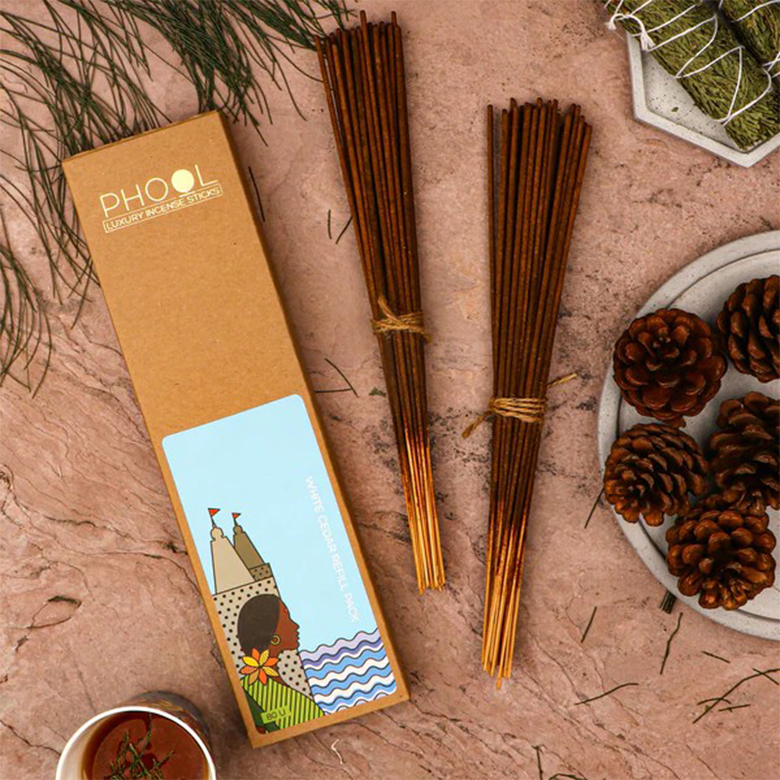
Most agarbatti sold in India is charcoal-based, which is cheap to produce but not something you want to breathe in daily, especially in a small room during a puja. Charcoal incense releases particulate matter at concentrations that indoor air quality researchers have flagged for years, and the synthetic fragrances layered on top rarely smell like what they claim to. Phool's incense skips the charcoal binder entirely. It's slower to light and burns a little differently, and if you've used mass-market agarbatti your whole life, that difference is noticeable in the first ten seconds. It smells like flowers because it is flowers.
The women who make it happen
The part of Phool's story that gets less attention than it deserves is who is actually doing the work. The company deliberately hires women who previously worked as manual scavengers, cleaning dry latrines and clearing sewage by hand, some of the most hazardous and stigmatized labor still done in India. At Phool, that same population sorts flowers and hand-rolls incense sticks instead. It's a shift from work that carries serious health risk and social stigma to work that doesn't. Agarwal has talked about this less as a CSR add-on and more as the actual point of the business: dignified employment was the goal, and incense turned out to be the product that made it viable.
Beyond incense: Fleather
In 2021, Phool's R&D team figured out that the mycelium growing on their discarded flower waste could be processed into a material with leather-like properties. They called it Fleather. It's animal-free, made from the same temple flowers, and it won PETA India's Best Innovation in Vegan Fashion award the year it launched. By 2022 it was a finalist for the Earthshot Prize, one of the more closely watched environmental awards globally. Fleather is still early compared to the incense business, but it says something about how the company thinks: the flower waste problem is big enough to solve more than once.
That kind of R&D doesn't run on goodwill alone. Phool raised an $8 million Series A backed by IIT Kanpur, Sixth Sense Ventures, the IAN Fund, and actress Alia Bhatt, among others. The funding round mattered less as a headline and more as proof that flowercycling could scale past a single city.
It's worth pausing on how unusual that investor mix is for a company built on collecting temple waste by hand. Institutional backing for a business this operationally messy, dependent on daily pickups, perishable raw material, and a workforce transitioning out of informal labor, doesn't happen just because the sustainability story is appealing. Investors were underwriting the logistics, not just the mission, which says something about how far past "nice idea" Phool had already proven itself before the round closed.
Packaging that doesn't oversell it
Open a box of Phool incense and there's no imagery of gods or temples, no gold foil, none of the visual shorthand most Indian incense brands lean on. The packaging is quiet: muted colors, clean type, a small note about where the flowers came from. It reads more like a considered home fragrance brand than a religious product, which is a deliberate choice. Phool is selling something used in daily ritual, but the design treats the buyer as someone furnishing a calm home, not someone who needs convincing that the product is spiritually authentic.
Sustainability without the sermon
What's easy to miss about Phool , if you only read the press release version, is how little the brand actually talks about saving the planet. There's no messaging about "eco-consciousness" plastered across the packaging, no lecture about your carbon footprint. The sustainability case is implicit: here's a real problem, here's what we built to fix a piece of it, here's the product. You can buy the incense because you like how it smells, and the fact that it kept flowers out of a river is almost a footnote.
That restraint is probably why the brand has held its credibility as it's grown. It would be easy for a company built on a genuinely good cause to lean on that story and let the product slide. Phool seems to understand that the quickest way to lose people's trust in a "sustainable" brand is to remind them constantly that they're supposed to feel good about buying it. Better to just make the incense worth lighting.