
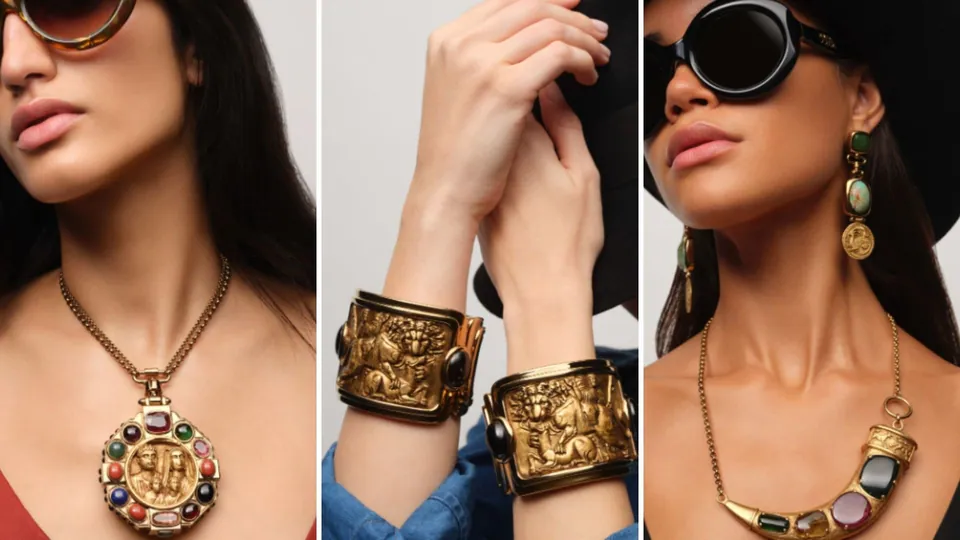
Sabyasachi Mukherjee and The Metropolitan Museum of Art have announced a multi-year collaboration, and the first chapter will arrive as a jewellery collection during New York Fashion Week in September 2026. The designer shared the news through his official channels, and it was reported the same day by WWD and Town & Country.
Sabyasachi’s return to New York Fashion Week was already known. That part is background. The new development is the relationship with the museum itself, and the decision to open it with jewellery rather than clothing.
The significance is easy to overstate and easy to miss. An India-based luxury house is attaching its jewellery business to the archive and institutional voice of one of the most visited museums in the world. What is not yet clear is the mechanism: how a museum reference travels from a collection object to a priced, wearable, commercially distributed product.
What is confirmed about Sabyasachi × The Met
Relationship: Multi-year collaboration between Sabyasachi and The Metropolitan Museum of Art
First chapter: Jewellery
Launch context: New York Fashion Week, September 2026
Reported presentation date: 15 September 2026, according to Town & Country
Reported historical focus: Byzantine world, according to Town & Country
Reported product count More than 100 pieces, according to Town & Country
Materials reported: 18- and 22-karat gold with gemstones including tourmaline, spinel, amethyst and lapis lazuli
Reported US price range: $2,500 to $100,000, according to Town & Country
Reported New York sales channels: Sabyasachi New York flagship after launch
India availability: Not confirmed
Commercial licensing terms Not disclosed
Future collaboration categories Not yet fully disclosed
Terminology note: WWD describes the first chapter as fine jewellery, while Town & Country calls it high jewellery. Sabyasachi itself uses High Jewellery and Fine Jewellery as separate product categories. Until the collaboration’s official product taxonomy is fully published, The Vantage uses “jewellery collection” as the neutral term.
The collaboration is the news, not Sabyasachi’s NYFW return
The chronology is worth keeping clean, because the two announcements have already begun to blur into one. Sabyasachi had earlier confirmed a return to the New York Fashion Week calendar, with Town & Country reporting a 15 September presentation. That was a schedule item.
What changed is the addition of an institutional partner. The museum relationship is described as multi-year, which means the September show functions as the opening chapter of something longer rather than a one-season capsule. Reading the show as the story would miss the more consequential part.
Why The Met changes the meaning of a historical reference
Designers have always worked from museums. Sketchbooks filled in gallery corridors, archive appointments, catalogue plates and photographs of objects behind glass are ordinary research tools in fashion and jewellery. Nobody needs a contract to be influenced by an eighth-century earring.
A formal collaboration is a different arrangement. Once an institution is named alongside a product, its collections, intellectual property, brand and interpretive voice may all become part of the commercial proposition. That can bring access and rigour. It can also convert scholarship into marketing shorthand if the detail is thin.
The exact contract structure here has not been disclosed, and it would be careless to assume one. What can be said is that the announcement moves the work from private reference to public, named partnership.
What the Byzantine starting point tells us
Town & Country reports that the first release draws on the Byzantine world. That is a useful choice, and a slippery one if handled loosely.
Byzantium was not a sealed European style. It was formed through movement across the Mediterranean, West Asia and further east, absorbing techniques, materials and motifs through trade, tribute, conquest and migration. Gold work, cloisonné enamel, cabochon settings and pearl-heavy ornament travelled in several directions at once. Sabyasachi has previously used Byzantine language within his own jewellery vocabulary, so this is not a sudden pivot.
Framed carelessly, a Byzantine collection made in India becomes an East-meets-West caption. Framed accurately, it is one of the better arguments against that framing, because the source material was already the product of exchange.
Indian-made does not mean only Indian-referenced
This distinction sits at the centre of the story. The pieces are described by the brand as handcrafted in India. The reported inspiration comes from museum holdings connected to regions and periods well outside the subcontinent.
So the shape of the project is not an Indian motif being exported for foreign consumption. It is Indian craft capacity and Indian design authorship interpreting a wider historical archive for an international customer. Those are different economic and cultural positions. The first is supply. The second is authorship, and it carries a claim about who is allowed to interpret whose history.
Keeping production, design and institutional authority separate also avoids the tired habit of describing Indian karigars as anonymous inherited labour. Setting, engraving, enamelling and stone work are skilled trades with named workshops and wage structures, not atmosphere.
Museum collaboration and museum endorsement are not the same thing
A collaboration confirms that an institutional relationship exists. It does not confirm a verdict.
It does not mean The Met has declared Sabyasachi India’s definitive luxury house. It does not mean every curator has approved every commercial interpretation. It does not mean the resulting products become museum objects, or that they enter any collection. Those are separate categories of fact, and the announcement addresses only the first.
This is not a criticism of the project. It is a caution about how such news tends to be summarised once it travels.
When does historical inspiration become museum commerce?
Museums are commercial operators as well as custodians. The Met runs a substantial retail business, and its own store already sells art-inspired fine jewellery drawn from the collection. Licensing programmes, reproductions and designer partnerships are standard practice across major institutions and often fund the unglamorous work of conservation and research.
The interesting question is therefore not whether a museum should sell jewellery. It is what additional value appears when a luxury house uses a museum collection as a formal design and commercial framework rather than as free public inspiration. Access, accuracy and named provenance are the plausible answers. None of them has been demonstrated publicly yet.
Museum reference, collaboration and endorsement are different things
Museum reference: A designer draws from an object, collection, period or visual language held or interpreted by a museum. No relationship is implied.
Museum collaboration: The designer and the institution work together under an agreed relationship, which may involve access, licensing, branding or product development.
Museum endorsement: A broader judgement of quality, cultural authority or ranking. A product collaboration should not automatically be read as this.
This glossary is editorial clarification by The Vantage, not a description of undisclosed contract terms.
The New York flagship matters as much as the runway
Town & Country reports that the jewellery will be sold through Sabyasachi’s New York flagship after the debut. That detail deserves more attention than the show date.
A fashion-week presentation buys concentrated attention for roughly a week. A permanent store on 160 Christopher Street, listed on the brand’s official store page, turns the collaboration into a standing retail proposition with trained staff, repeat clients and the slow conversations that high-value jewellery actually requires. Nothing about sell-through or demand can be inferred from the announcement, and reported price bands are not sales figures.
This is also a global-positioning move for Indian jewellery
Sabyasachi’s official history records a jewellery business that has been building international distribution for years, including presence at Bergdorf Goodman, Harrods and Printemps Doha, alongside the New York flagship and sustained red-carpet visibility, including the brand’s Met Gala 2025 dressing.
Read against that record, the museum relationship extends an existing international strategy rather than starting one. The change is in kind, not in ambition. The house is moving from selling into global luxury retail to co-authoring a cultural product with a global institution.
The missing object-by-object references matter
Here is where the collaboration will either become genuinely documentable or remain a mood.
If a necklace is informed by a specific reliquary, a mosaic border, a particular enamel technique or a class of objects in a named department, saying so converts marketing language into usable cultural information. It lets buyers, students, curators and writers check the claim. It credits the historical makers as well as the modern ones. It also makes the Indian workshop’s technical contribution legible, because you can see what was interpreted and how.
Not every piece in a collection of more than 100 will have a single direct source, and it would be wrong to demand that fiction. But an accessible reference list for the pieces that do would be the difference between a collaboration that adds to the record and one that borrows an institution’s prestige.
What we are still verifying
Whether the official first chapter is classified as Fine Jewellery, High Jewellery or both
Full product count
Complete piece list
Exact Met artworks, objects or architectural references connected to each piece
Museum departments or curators involved
Commercial licensing and revenue-sharing terms
Whether The Met receives royalties
India retail availability
India pricing
Online availability
Other global retail channels
Whether future chapters include clothing, accessories, objects or other categories
Whether each future chapter will draw on a different museum collection
What would make this collaboration genuinely useful to document
The Vantage will maintain the reference table below and populate it only when individual references are publicly documented by Sabyasachi or The Met. No rows have been invented.
PieceMet referenceHistorical periodRegionMaterialIndian techniqueArtisan locationPriceAvailabilityTo be published when object-level references are confirmed.
The larger shift is not that Indian jewellery has finally been made legitimate because a New York museum is involved. Indian jewellery has long histories, deep technical traditions and a documented global market of its own. What is moving is the distribution of cultural authority. An Indian house is using its own design and manufacturing infrastructure to interpret a major international archive for a global luxury customer, and it is doing so under its own name.
Whether that becomes a serious piece of cultural work or an expensive reference to one depends almost entirely on how much of the detail is published between now and 15 September.
Frequently asked questions
What is the Sabyasachi and The Met collaboration?
It is a multi-year collaboration between the Indian luxury house Sabyasachi and The Metropolitan Museum of Art, announced by the designer and reported by WWD and Town & Country. The first chapter is a jewellery collection.
When will the first Sabyasachi × The Met jewellery collection launch?
During New York Fashion Week in September 2026. Town & Country reports a 15 September 2026 presentation date.
Is the first chapter fine jewellery or high jewellery?
Reporting differs. WWD describes it as fine jewellery, while Town & Country calls it high jewellery. Sabyasachi treats the two as separate categories, so The Vantage uses the neutral term jewellery collection until the official taxonomy is published.
What inspired the first collection?
Town & Country reports that the first release draws on the Byzantine world. Object-by-object references have not been published.
How many pieces are in the collection?
Town & Country reports more than 100 pieces. A final count has not been confirmed.
Where will the jewellery be sold?
Town & Country reports sales through Sabyasachi’s New York flagship at 160 Christopher Street after the launch. Other channels have not been confirmed.
Will the Sabyasachi × The Met collection be available in India?
Not confirmed at the time of drafting. No India launch date, retail channel or pricing has been announced.
Is this a Metropolitan Museum of Art exhibition?
No. Based on current confirmed information it is a product collaboration launching around New York Fashion Week, not an announced Met exhibition.
Does The Met collaboration mean the museum endorses Sabyasachi above other designers?
No. A collaboration confirms an institutional working relationship. It is not a ranking of designers or a judgement on other houses.
What details are still undisclosed?
Licensing terms, any royalty arrangement, curator or department involvement, the full piece list, object-level references, India availability and pricing, online sales and the categories of future chapters.