
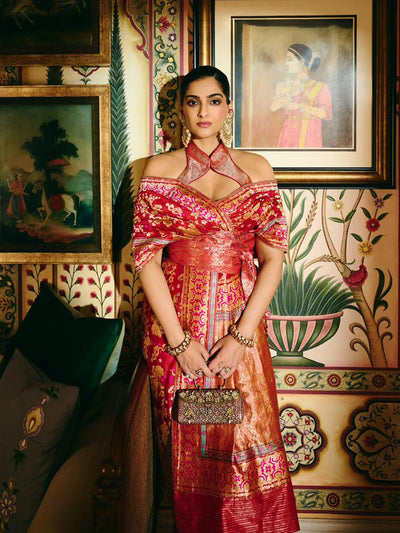
Bharat Shah had spent his professional life in Banarasi textiles not as a weaver but as a trader, a man who understood the market from the selling side, who knew which sarees moved and which did not, which qualities commanded premium and which were indistinguishable from the mid-tier. When his daughter Palak joined the family business in 2009 and began asking questions that the trade had long stopped asking about the hours in a piece, the years of training the weaver represented, the difference between the handloom and the power-loom already displacing it the answers they found together were not comfortable ones.
A handloom Banarasi saree of the kind that Bharat Shah's family had been trading for decades might take a weaver forty hours to produce. In the market as it was structured, the weaver received perhaps eight hundred rupees for those forty hours twenty rupees an hour for work that required years of apprenticeship, specialised equipment, and the concentrated attention of a trained body. The power-loom that was taking market share could produce a visually similar saree in an hour, at a fraction of the material cost, and sell it at a price that the handloom weaver could not compete with on volume. The market, as it was constituted, was optimised to make the handloom economically non-viable.
Palak Shah founded Ekaya in 2012 with a premise that was both simple and, in the context of the Banarasi trade, unusual: that the handloom saree should be priced to reflect its actual cost of production. Not the cost that the intermediary structure had suppressed, but the real cost the weaver's forty hours, calculated at a rate consistent with skilled artisanal work, plus the material, plus the overhead of the studio, plus a margin that allowed the business to sustain itself and the weaver to sustain a family. This was not charity. It was accurate pricing.



The market Ekaya created was not the mass market for Banarasi sarees. It was a smaller market of buyers who understood what they were purchasing who could read the difference between a handloom kadwa weave and a power-loom imitation, and were willing to pay the price difference that the difference in making warranted. This market required education the label's communication has always included detailed explanation of the technique, the weaver's training, the time and it rewarded that education with a customer who returned, who referred, who understood the object well enough to value it correctly.
In 2026, Ekaya's model is not merely commercially successful. It is the model that the Indian handloom sector needed to prove was possible.