
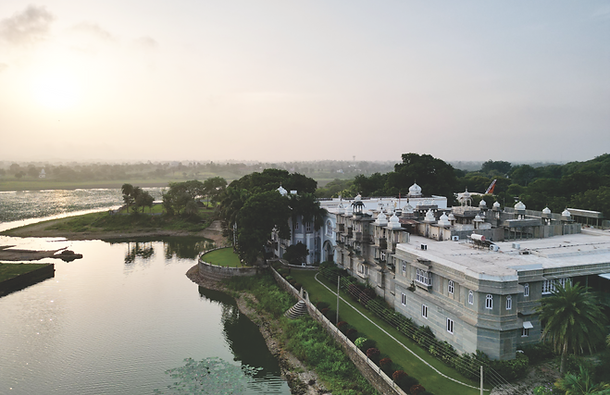
Dungarpur does not appear in the usual itinerary. The small city in the forested hills of southern Rajasthan named for the dungars, the hills that ring it is not on the direct route between Udaipur and Ahmedabad, though it sits between them; not on the road to Jaisalmer or Jodhpur or any of the cities that Rajasthan tourism has placed on its circuit. This is its particular virtue. Dungarpur has not been prepared for visitors. It simply exists, as it has existed since the 14th century, doing what it does.
The stone that defines Dungarpur's architecture is pareva a blue-grey slate quarried from the same hills that rise behind the town, found nowhere else in quite this colour and quality. Pareva does not warm to amber in the evening light, as Jaisalmer's limestone does, nor does it carry the pink warmth of Jaipur's sandstone. It holds its blue-grey quality at all hours, giving the Dungarpur built environment a coolness that belongs specifically to this place. The havelis of the old city, the ghats that descend to the Som River, the temple towers carved from pareva in intricate patterns all of it belongs to a visual world that is specifically here, nowhere else in Rajasthan.
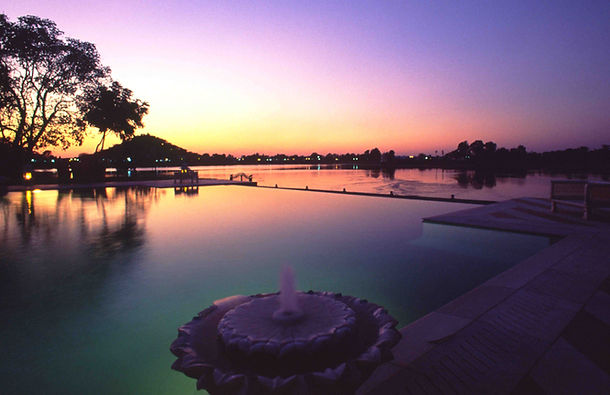
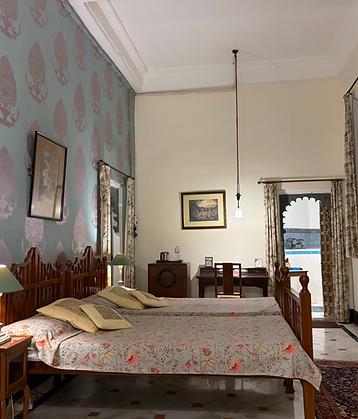
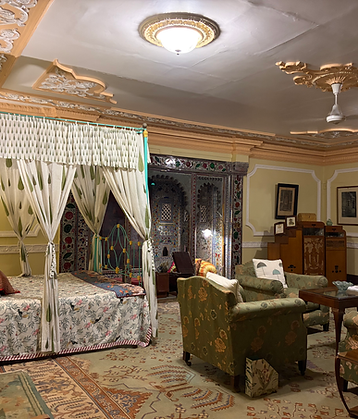
Udai Bilas Palace, built on the edge of Gaibsagar Lake in the 19th century by the Maharawal of Dungarpur, is run today by the family that built it. The building is a conversation between Rajput and Mughal architectural languages, with pareva stone throughout the floors, the columns of the courtyard, the jali screens that filter the lake light into the rooms. The fresco work in the private apartments uses a palette drawn from local mineral tradition: greens from malachite, blues from lapis lazuli brought through old trade routes, the distinctive Dungarpur ochre from local soil. These are not restored frescoes. They are maintained ones the family has never stopped living here, and a lived building is maintained differently from a conserved one.
To arrive at Udai Bilas by boat across Gaibsagar, as guests do at certain hours when the lake is right, is to arrive the way everyone arrived before the road: by water, from the lake's surface, the palace revealed gradually as the boat moves across the blue-grey water toward it. The pareva stone at that hour, reflected in the lake, is the colour of a sky that is thinking about rain.