
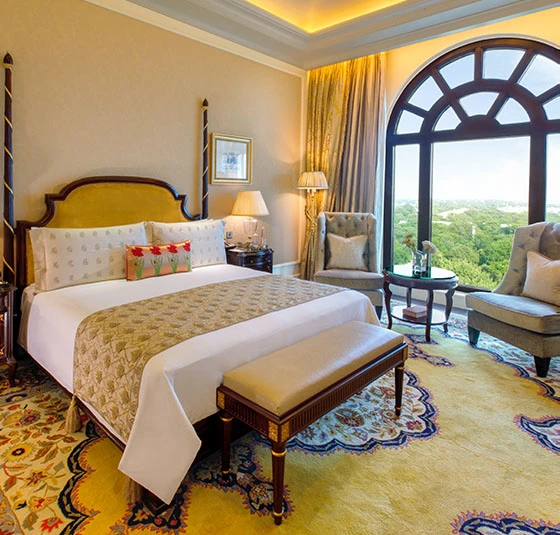
The Leela has reported a 460% rise in profit for the quarter ended 30 June 2026, with its average daily room rate crossing ₹20,000. Operating revenue rose 28% year on year to ₹352 crore, operating EBITDA rose 41% to ₹143.4 crore, and profit for the period reached ₹48.8 crore. The average daily rate stood at ₹20,722, up 10%, with occupancy at 67.5%.
That ₹20,722 figure deserves an immediate caveat, because it is the number most likely to be misread. Average daily rate is a portfolio average of what occupied rooms earned across the company’s hotels, palaces and resorts over three months. It is not a tariff, and not the price of any particular room on any particular night. Some guests paid considerably more; many paid less.
Still, the direction is the story. Rates are rising, occupancy is holding, and margins are widening. For travellers, wedding hosts and corporate buyers, that raises a question the results themselves cannot answer: what, exactly, is the higher price buying?
The Leela Q1 FY27 results at a glance
Operating revenue: ₹352 crore | +28% year on year
Operating EBITDA: ₹143.4 crore | +41%
Operating EBITDA margin: approximately 41%
Profit for the period: ₹48.8 crore | +460%
Average daily rate: ₹20,722 | +10%
RevPAR: ₹13,982 | +17%
Occupancy: 67.5%
Net debt: ₹1,331.9 crore at 30 June 2026
Reporting period: Quarter ended 30 June 2026
ADR, RevPAR, occupancy and EBITDA—what the hotel numbers mean
ADR (average daily rate): the average revenue earned for each room that was actually occupied. It says nothing about rooms that stayed empty.
Occupancy: the percentage of available rooms that were sold during the period.
RevPAR (revenue per available room): room revenue spread across every available room, whether occupied or not. It is commonly calculated as ADR multiplied by occupancy, which is why it is always lower than ADR unless a hotel is completely full.
Operating EBITDA: operating earnings before interest, tax, depreciation and amortisation. It is useful for comparing operating performance across periods, but it is not net profit and it is not cash flow.
Why did The Leela’s profit rise so sharply?
The three headline growth rates — 28% revenue, 41% operating EBITDA, 460% profit — are not three measures of the same thing. They are a demonstration of operating leverage, and of arithmetic.
Hotels carry a high proportion of fixed costs. Staff, maintenance, utilities and upkeep do not fall away when a room goes unsold, nor rise proportionally when one sells at a higher rate. Once those costs are covered, incremental revenue flows through to operating earnings at a far better ratio. That is why operating EBITDA grew faster than revenue, and why the company has described the quarter’s roughly 41% operating EBITDA margin as its highest first-quarter margin.
The 460% figure needs more care. Below operating EBITDA sit interest, depreciation and tax, largely fixed in the short term. When those charges consume most of a modest operating profit, the residual profit line is small — and a small comparison base produces a very large percentage change. The improvement is real; the percentage is amplified by where the comparison started, and it does not mean every additional rupee of revenue converted into profit.
A ₹20,722 ADR does not mean every room costs ₹20,722
A traveller who reads the ADR figure and then opens a booking page will almost certainly see a different number, in either direction. Several variables sit between a portfolio average and a final bill.
Room category comes first: a base room, a club room and a palace suite occupy different price bands within the same property, and an average blends all of them. Destination and dates matter just as much — a metro business hotel on a weekday and a resort in peak season price on entirely different logic, and festival periods, wedding season and conference calendars move rates far beyond any annual average. Taxes and mandatory charges sit on top of the displayed rate, packages that include meals or transfers carry higher headline rates but may cost less in total, and a refundable rate and a non-refundable rate for the same room on the same night are not comparable prices.
The honest reading is narrow and useful: across three months and a whole portfolio, occupied rooms earned about 10% more than they did a year earlier. That is a statement about the company’s pricing, not a quotation for a guest.
Pricing power is real—but limited luxury supply matters
Rising rates alongside 67.5% occupancy indicate genuine pricing power: prices rose without emptying rooms. The more interesting question is where that power comes from. Reuters has reported on the combination shaping Indian luxury hospitality — a growing affluent traveller base set against a shortage of luxury rooms. Building a five-star property in a prime Indian location is slow, capital-intensive and constrained by land, approvals and construction timelines. Demand can rise in a season; supply cannot. When a market has more buyers than premium rooms, rates rise for reasons that have little to do with what happens inside any individual hotel.
This is the distinction worth holding on to. Scarcity strengthens rates. So does improved service, better food and beverage, renovated rooms and sharper guest experience. The results disclose the outcome, not the cause. A higher ADR is evidence that the market accepted a higher price; it is not, on its own, evidence that the product improved.
Weddings, MICE and domestic leisure are not interchangeable demand
Management has linked the quarter’s growth to domestic leisure demand, MICE activity, pricing power and portfolio expansion. These are frequently listed together, which obscures how differently they behave.
Domestic leisure responds to holidays, destination appeal and the short-break habit that has reshaped Indian travel. It books closer to the date and is sensitive to weather, connectivity and sentiment.
MICE — meetings, incentives, conferences and exhibitions — runs on corporate budgets and planning cycles. It books earlier, arrives in volume, and monetises far more than rooms: banquets, catering and evening functions. A conference can be worth more per guest than a leisure stay at the same rate.
Weddings behave differently again, combining room blocks, event spaces, sustained food and beverage spending, décor coordination and multi-day occupancy across an entire property. They are highly seasonal, negotiated well in advance, and can swing a quarter either way depending on the calendar.
The company has not separately disclosed how much each segment contributed, so assigning proportions would be invention. What can be said is that the three streams carry different lead times, margins and vulnerability to a slowdown.
From hotel stays to an affluent-lifestyle ecosystem
Read alongside the quarter’s announcements, the strategy looks less like hotel-keeping and more like an ecosystem built around affluent Indian consumption. Private members’ clubs, destination dining, wellness, residences, events and nature-led stays each extend the relationship beyond the night a guest sleeps in a room.
The commercial logic is straightforward. A room can be sold only once a night, at a price capped by the market. A membership, restaurant, spa or branded residence sells to the same guest on nights they are not staying, often at better margins, and converts an occasional traveller into a recurring one.
For guests, this is neither automatically good nor bad. It can mean better facilities and a more layered experience; it can equally mean that parts of a property once included in a room rate become separately priced tiers. Which one a traveller meets depends on execution, and execution is not visible in a quarterly result.
ARQ shows why hotels want revenue beyond the room
ARQ, the company’s private-members’ club platform, is the clearest expression of that thinking, and a second ARQ club has been reported in New Delhi. The Leela’s own material presents ARQ as a membership-led expression of privilege and access across its palaces, hotels and resorts — a curated ecosystem rather than a single venue.
What the company has not disclosed matters equally: member numbers, fees, revenue contribution and profitability were not published with the results. Without those, ARQ can be described as a strategic direction, not measured as a business line. Membership platforms can be highly profitable or expensive brand exercises; nothing in the public record yet settles which this is.
Coorg and Tadoba expand the meaning of a Leela destination
In July 2026, the company launched The Leela Coorg Forest Sanctuary, extending the brand into a nature-led setting rather than a palace or a city address. Separately, it has disclosed a planned 30-key resort near Maharashtra’s Tadoba Tiger Reserve, across approximately 62 acres, with an estimated investment of about ₹120 crore and a target completion year of 2030.
Small-key, high-rate wildlife and forest properties are among the strongest-performing formats in global luxury hospitality, and Indian demand for them has grown. They also invite scrutiny a city hotel does not: construction near protected habitats raises legitimate questions about environmental clearances, water use, waste management, buffer-zone rules, wildlife corridors and how tourism revenue reaches surrounding communities. Raising them is not an allegation of wrongdoing; it is the standard by which such projects are now assessed, and answers usually emerge through the approval process rather than at announcement.
It is also worth noting that a 2030 completion target is four years away. Investment figures, key counts, permissions and timelines commonly change over that horizon, and should be treated as current intent rather than commitment.
Does a higher room rate deliver better value?
This is where the company’s numbers and the traveller’s experience diverge. A higher ADR proves rooms sold at higher prices. It does not prove the service was warmer, the breakfast better or the wait shorter. Value is judged at the property, on the date, in the room category actually booked.
What travellers should compare before accepting a higher luxury-hotel rate
Same room category and cancellation terms — a refundable club room and a non-refundable base room are not the same offer.
Taxes and mandatory charges — compare all-in totals, not displayed nightly rates.
Breakfast and airport transfers — inclusions change the effective cost of a multi-night stay.
Lounge, club or butler access — what is included, and what is a paid upgrade.
Event or peak-date pricing — shifting dates often changes the price more than changing hotels.
Renovation status — ask whether the property, wing or restaurant is under work during your stay.
Service consistency and recent guest feedback — read for patterns rather than single incidents.
Flexibility, upgrades and late checkout — often worth more than a marginally lower rate.
Whether the experience is hotel-led, destination-led or event-led — a hotel barely seen during a wedding week is judged differently from one you travelled to stay in.
None of this points to a single property or booking. It is a way of testing whether a higher price corresponds to a larger experience.
The balance sheet still matters
Net debt stood at ₹1,331.9 crore at the end of June 2026. In a strong demand cycle with widening margins, debt of that order is manageable. It stays relevant because hospitality is cyclical and capital-intensive: new properties, clubs and resorts consume cash long before they generate it, and interest costs do not soften when occupancy does.
That is an observation about how the business is financed as it grows, not a view on valuation, share price or investment merit. This article offers none of those.
What remains unknown
What we are still verifying
Contribution from rooms, weddings, MICE, food and beverage and leisure
Performance of individual hotels
International versus domestic guest mix
ARQ member count, fees and revenue contribution
Owned-versus-managed contribution to growth
Current pipeline opening dates
Final Tadoba investment and permissions
Guest satisfaction trends compared with room-rate increases
City and destination-level ADR and occupancy
Until those are disclosed, the quarter is best read as a portfolio-level result. It does not establish that every hotel, city or resort performed alike, and no such claim should be drawn from it.
What travellers and the market should watch next
The quarter demonstrates two things clearly: affluent Indian demand for luxury hospitality is strong, and The Leela has converted it into higher rates, wider margins and sharply higher profit. Whether that continues depends on the supply of new luxury rooms, the durability of MICE and wedding budgets, the seasonality of the calendar and the group’s ability to fund expansion. One strong quarter is a data point, not a guarantee.
For travellers, the more pressing question is narrower and harder. As rates rise, does the experience expand in proportion to the price? Better numbers are being reported by the company; better stays must be verified by guests, property by property, over time.
What the results really reveal is how the terms of competition have shifted. Indian luxury hospitality is no longer a contest for rooms alone. It is a contest for weddings, memberships, destinations, dining, time and attention — and the winners will be decided less by what they can charge than by what they can convincingly deliver.