
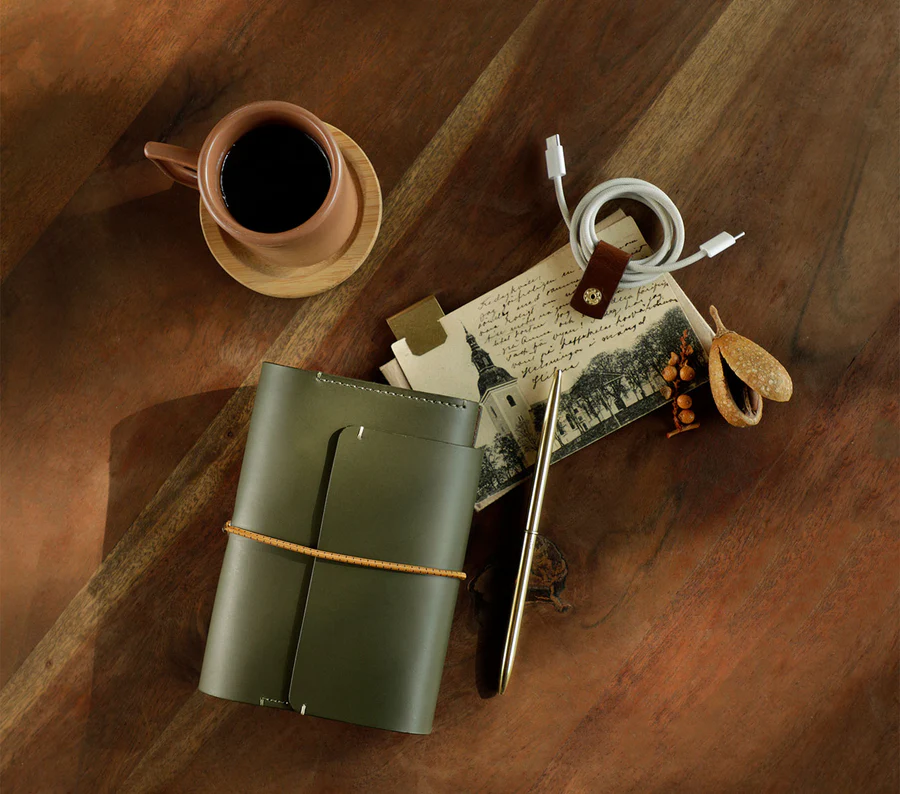
The Delhi leather atelier founded by Gautam Sinha has been making objects that age better than almost anything else you will own. Nappa Dori whose name translates from Hindi as leather and thread operates from a design philosophy that is deceptively simple: make the thing well, make it so that it lasts, and trust that the person who finds it will recognise the intelligence of that decision.
The studio's bags are the most obvious place to begin, but beginning there is like describing a library by the colour of its binding. The leather itself is the argument full-grain, vegetable-tanned, handled by craftsmen who understand that the material is not a surface to be controlled but a collaborator to be worked with. A Nappa Dori bag does not resist ageing. It receives it. The leather darkens at the handles first, then at the clasp, then at the corners, each mark a record of use that makes the object more itself over time.
The accessories line extends this logic outward. The leather journals stitched, blocked, designed to sit on a desk with the particular authority of things made for the purpose of holding ideas are objects that make the act of writing feel considered. The pencil cases, the card holders, the luggage tags: each piece follows the same internal principle, which is that a well-designed small object is never small in its presence.
"A Nappa Dori piece does not resist ageing. It receives it and becomes more itself over time."
Sinha's design language draws from two traditions simultaneously: the Indian craftsmanship that has always understood leather as a material worth respecting, and the European minimalism that has always understood design as the art of removing everything that isn't necessary. The collision of these two sensibilities produces objects that feel neither exotic nor derivative. They feel precise.
The studio has a physical presence in Delhi at Khan Market and Lodhi Colony, and the shops themselves are worth understanding as objects: clean, uncluttered, light-filled spaces where every piece has room to exist independently. There are no stacks, no sales rails, no urgency. The Nappa Dori store experience communicates the same thing the products communicate that quality does not need to announce itself.
The homeware range trays, bookends, desk accessories, photo frames extend the Nappa Dori language into the domestic interior. A brass-and-leather tray on a coffee table reads differently from any other tray. It has a specificity, a sense that someone decided exactly where the leather should meet the metal and why. These are not decorative objects in the passive sense. They are objects with opinions.
What makes Nappa Dori unusual in the contemporary landscape of Indian design is its refusal to perform Indianness as a surface quality. There are no motifs borrowed from temple architecture, no block prints applied to make the leather more recognizably Indian. The Indianness of the work lies deeper than that in the craft tradition, in the relationship between maker and material, in the patience that makes a hand-stitched edge different from a machine one in ways that only become apparent after the object has been in your life for a year.

The person who chooses a Nappa Dori piece is choosing something specific: the certainty that the object will age with them, that it will not be superseded by a newer version next season, that it will sit on the desk or hang on the shoulder in five years' time with exactly the same authority it has today. That is a different kind of luxury from the kind that announces itself. It is quieter, more demanding, and considerably harder to achieve.