
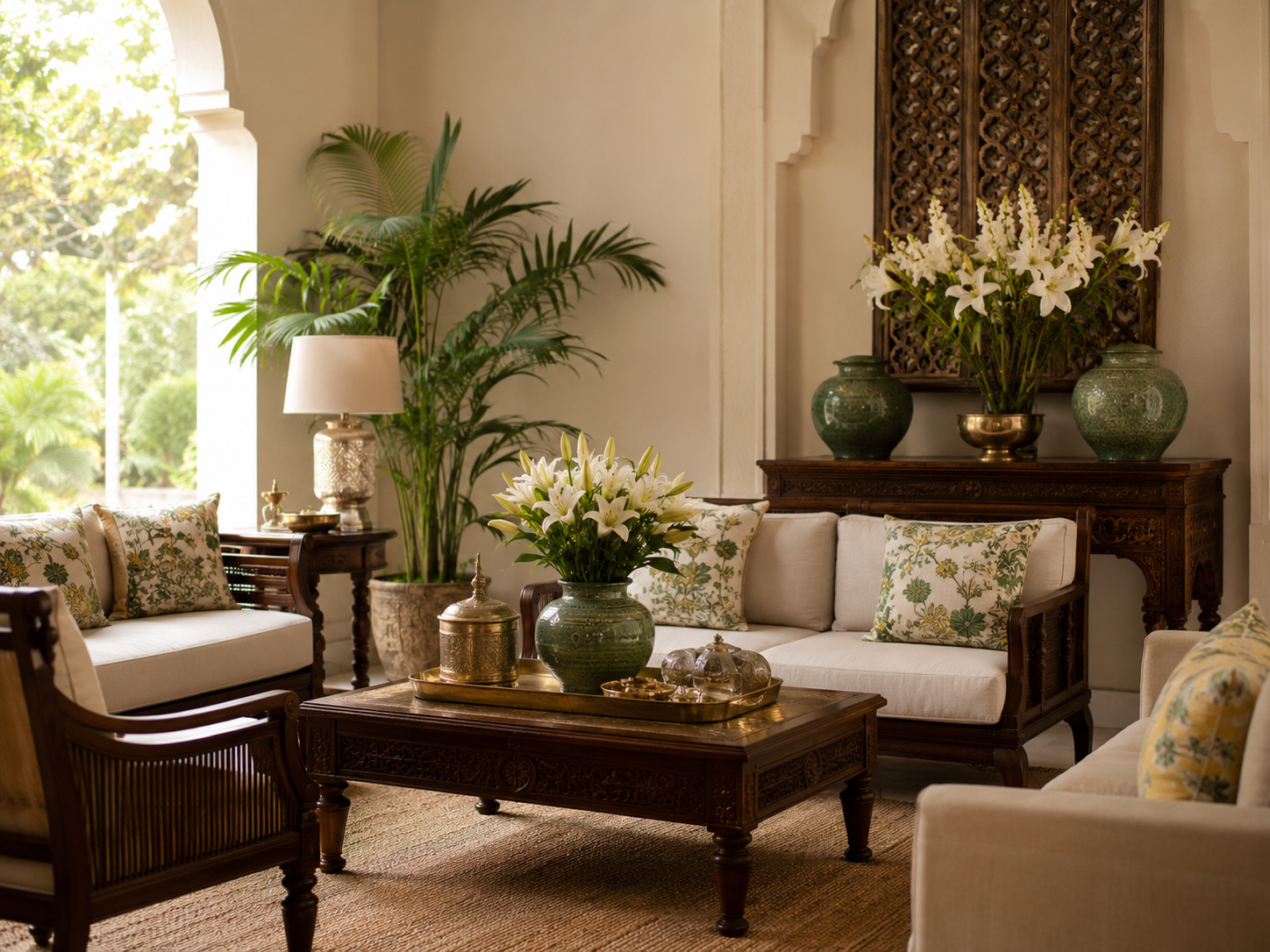
There is a quality that distinguishes a room made with handcrafted objects from one merely furnished with them. It is not visible in any single item. It is the aggregate effect of things made by individuals the slight asymmetry in a block-printed cloth, the fingerprint-smooth surface of a thrown-clay cup, the way a hand-forged brass hook catches light differently depending on where you stand.
Good Earth has been building such rooms since 1996 or more precisely, making the objects that allow other people to build them. Founded by Anita Lal with the purpose of reviving India's village crafts, the brand works directly with artisans practicing traditions from Bagru block printing to Bidri metalwork.
Bagru, a small town near Jaipur, has been a centre of natural-dye block printing for centuries. The Chhipa community of printers there work with a palette derived entirely from natural sources: indigo from the plant Indigofera tinctoria; alizarin from madder root; iron mordant from a solution of fermented iron filings in jaggery water.
Bidri metalwork, from Karnataka, represents the other end of the craft vocabulary Good Earth works with. An alloy of zinc and copper is cast into forms vases, trays, decorative panels then inlaid by hand with silver wire hammered into channels cut with a chisel.
Their apparel collections follow the same logic as the objects. A block-printed kurta from Good Earth is cut and dyed using the same principles the brand applies to its home range: craft first, product second.
What Good Earth has long understood and what the global interior conversation in 2026 is beginning to articulate is that handmade objects function differently in a space. They carry a weight that manufactured objects do not. Not physical weight, but something closer to presence.
In an era of interiors that trend globally and rooms that photograph identically across continents, Good Earth continues to make things that could only come from here from this tradition, this colour, this understanding of how a printed cloth should fall against a white wall in morning light.